
If you have spent any time recently scrolling through property forums or chatting with neighbours who have just ripped up their living room carpet, you will have noticed a growing frustration. Damp. Muddy paw prints. The relentless march of condensation across Victorian bay windows. After the wettest eighteen months on record in parts of England and Wales, and with energy bills still hovering at levels that make you wince every time the heating clicks on, British homeowners are rethinking what they walk on. The short answer from surveyors and builders is this: the old default of fitted carpet everywhere no longer makes sense. Finding the best flooring options for UK homes has shifted from a design question to a practical, financial, and even health-related decision.
Three specific pressures are driving this change. First, the UK saw 11% more rainfall than the long-term average in 2024, according to the Met Office, which means ground moisture levels under suspended floors are higher for longer periods. Second, energy costs remain roughly double what they were in 2020, making thermal efficiency a genuine financial concern rather than a green luxury. Third, the rise of hybrid working means people spend more hours inside their homes, noticing small issues like cold draughts from floorboards or the way a cheap laminate swells near the back door. This combination of factors has forced a re-evaluation of what actually works.
The old assumption that you carpet the living room and hallway, tile the bathroom and kitchen, and laminate the bedrooms no longer holds. Professional installers across the country report that customers are now asking for waterproof or water-resistant materials in every ground-floor room, regardless of its traditional label. A front hallway in Manchester faces the same wet shoes and umbrellas as a utility room in Plymouth. This shift in mindset is the single most important development in the UK flooring market over the past five years, and it directly shapes what experts now consider the best flooring options for UK homes.
Why British Homes Demand a Different Approach to Flooring
The UK housing stock is famously old, quirky, and thermally inefficient. Around a third of homes in England were built before 1946, many with solid concrete floors or suspended timber ground floors that breathe poorly when covered with the wrong material. Add in the fact that average relative humidity indoors often sits between 60% and 75% for months on end, and you have a recipe for mould, lifting edges, and that faint musty smell that no air freshener can mask. For years, homeowners focused purely on looks. Now, the conversation has turned to moisture resistance, insulation value, and long-term durability under real British conditions.
Three specific characteristics set UK homes apart from those in drier or more modern housing stocks. Suspended timber floors, common in houses built between 1890 and 1960, rely on airflow from air bricks to keep the timber joists dry. Covering these floors with a non-breathable material like foil-backed laminate or sheet vinyl can trap moisture, leading to rot and fungal growth within three to five years. Solid concrete ground floors, typical of post-war housing, tend to be cold and prone to surface condensation unless properly insulated and damp-proofed. Period properties with original flagstones or quarry tiles often have no damp-proof membrane at all, meaning any floor covering must allow moisture vapour to escape.
The best flooring options for UK homes therefore start with an honest assessment of what sits beneath your feet. Lift a corner of the existing floor covering if you can, or check the property deeds for build date and construction type. A quick test involves taping a square of clear plastic sheeting to the floor for 24 hours. If condensation forms underneath, you have rising damp or a missing vapour barrier. If condensation forms on top, the room has high ambient humidity. Both conditions will destroy unsuitable flooring within months. Matching the material to the subfloor is not optional pedantry; it is the difference between a floor that lasts twenty years and one that curls, cracks, or blackens before the guarantee runs out.
How the Shift to Hybrid and Waterproof Materials Reshaped the Market
Walk into any major flooring retailer in Manchester, Glasgow or Bristol today, and you will notice something striking. Laminate and engineered wood have been pushed to the side aisles. In their place, hybrid flooring and rigid core LVT (luxury vinyl tile) dominate the front displays. These materials combine a stone-plastic composite core with a printed vinyl top layer and an integrated underlay. They are fully waterproof, click together without glue, and can be fitted over existing tiles or uneven subfloors with minimal prep. For a typical three-bedroom semi in Leeds or Cardiff, hybrid flooring costs between £35 and £65 per square metre installed, which puts it squarely in the mid-range.
Three advantages explain why hybrid flooring has overtaken traditional laminate. First, the stone-plastic core expands and contracts less than the HDF (high-density fibreboard) core used in most laminates, which means you need smaller expansion gaps and can run the flooring continuously through doorways without transition strips. Second, hybrid planks can be cut with a standard utility knife rather than a power saw, reducing installation time by roughly 20% for a professional fitter. Third, the attached underlay pad, usually made from cork or recycled foam, provides acoustic insulation that meets the requirements of the Building Regulations Approved Document E for noise transmission between floors.
When homeowners search for the best flooring options for UK homes, hybrid consistently ranks at the top for bathrooms, kitchens, and utility rooms. However, it is not a universal solution. Hybrid flooring is not suitable for rooms with direct sunlight exposure for more than six hours a day, as UV degradation can yellow the wear layer within three to five years. It also softens slightly in very high temperatures, meaning a heavy piece of furniture left in one spot during a summer heatwave can leave a permanent indentation. For north-facing rooms, hallways, and ground-floor extensions, though, hybrid offers a compelling balance of price, performance, and waterproofing.
Deep Dive Analysis of Flooring Types That Actually Last
Let us get specific. Not every room in your house needs the same treatment, and pretending otherwise is where most renovation regrets begin. This section examines the five main flooring categories that genuinely perform under UK conditions, drawing on installation data and long-term performance records from industry sources. Each material has a clear use case, a set of non-negotiable requirements, and a realistic lifespan expectation. Ignoring any of these details will cost you more in replacements than you saved on the initial purchase.
Three key performance metrics matter more than brand names or aesthetic trends. Water resistance measures how long the flooring can stay wet before absorbing moisture. Thermal resistance, measured in tog or R-value, determines how much warmth it adds to a room when used over uninsulated ground floors. Acoustic performance, measured in decibel reduction, affects both your comfort and your legal obligations in flats or maisonettes. The best flooring options for UK homes will balance these three metrics against your specific room conditions and budget. No single material excels at all three, which is why professionals mix flooring types across different floors and rooms.
A note on installation before we continue. The most expensive flooring in the world will fail if fitted incorrectly over an unprepared subfloor. Budget for levelling compound, primer, and a qualified fitter who understands moisture testing and expansion gaps. The industry standard is to leave a 10mm to 12mm gap around the perimeter for any click-fit product, covered by scotia beading or removed skirting boards. Skipping this step accounts for roughly 40% of all flooring failure claims handled by the Consumer Ombudsman each year. Do not be that statistic.
Engineered Wood Still Leads for Living Rooms and Hallways
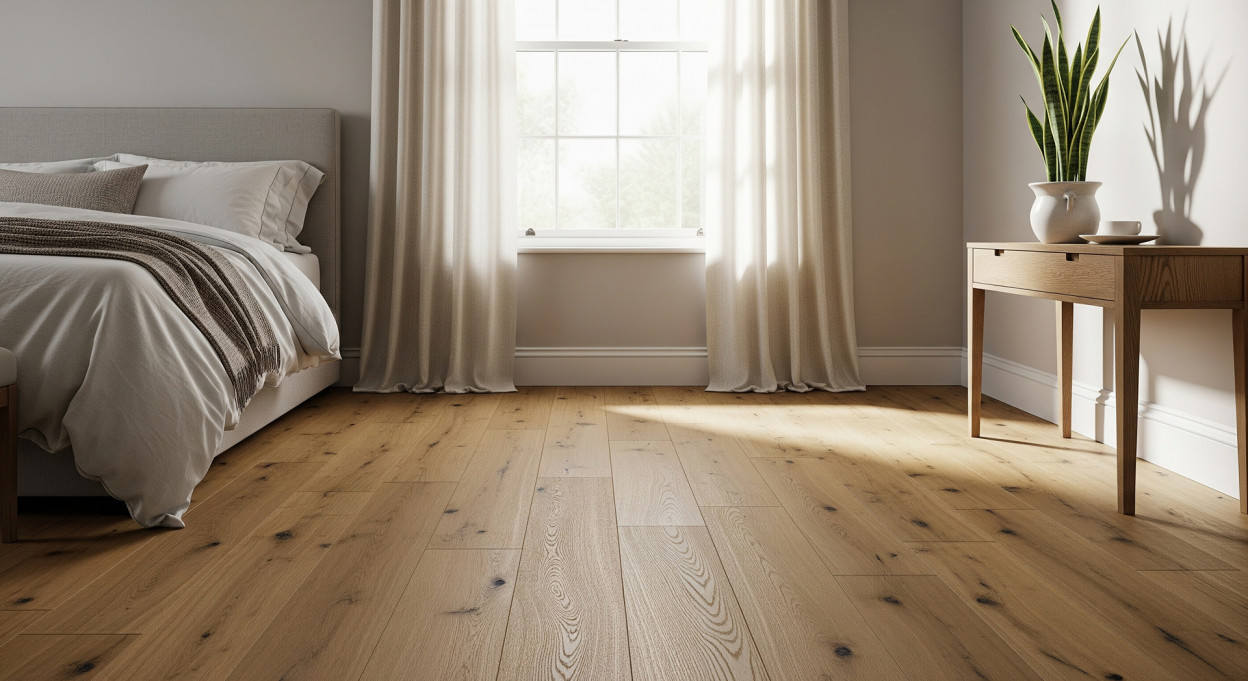
Solid wood flooring has become a niche product for period properties with stable humidity controls and whole-house ventilation systems. For everyone else, engineered wood is the smarter play. It consists of a top layer of real oak, walnut or ash bonded to multiple layers of plywood or HDF in a cross-grained construction. This cross-layer design handles temperature swings and moisture changes far better than solid planks. In a living room with a working fireplace and double-glazed windows that steam up each morning, engineered wood will stay flat while solid wood would cup or gap within a single heating season.
Three specifications determine whether engineered wood will last or disappoint. The total thickness should be at least 14mm for a standard suspended timber subfloor or 18mm for installation over concrete with battens. The top veneer, known as the wear layer, must be at least 3.5mm thick to allow for one or two sanding and refinishing cycles over the floor’s lifetime. The core material should be birch or poplar plywood, not low-density fibreboard, which can crumble if exposed to a leak. Many cheaper engineered boards use a 1.5mm veneer and an unknown core, making them essentially disposable after five years.
The best flooring options for UK homes with underfloor heating almost always start with engineered wood, because it transfers heat efficiently and does not expand excessively. The maximum recommended board width for heated floors is 180mm; anything wider risks gapping as the timber dries out cyclically. Expect to pay £50 to £90 per square metre for a decent 14mm to 18mm board with a 4mm wear layer. At that price point, you are looking at brands like Kahrs, Havwoods, or British hardwoods from suppliers such as Alternative Flooring. Installation adds another £25 to £35 per square metre, plus underlay and DPM if required.
- Lifespan: 25 to 40 years with proper maintenance and one refinishing
- Best rooms: Living rooms, dining rooms, hallways, ground-floor studies
- Avoid if: You have pets with untrimmed claws or a history of washing machine leaks
Porcelain Tile Remains Unbeaten for Wet Areas and Mudrooms
Porcelain tile is not glamorous, and it is cold under bare feet in December. But no other material handles standing water, bleach, pet accidents, and gritty boots with the same indifference. For a downstairs loo, a utility room, or a back entrance that opens directly onto a garden, porcelain tile is the workhorse choice. It does not stain, does not rot, and does not harbour dust mites or mould spores. The manufacturing process presses clay and feldspar under extreme pressure and fires it at over 1,200 degrees Celsius, creating a material with less than 0.5% water absorption. By comparison, cheaper ceramic tiles absorb up to 3%, which allows freeze-thaw cracking in unheated spaces.
Three technical distinctions separate good porcelain from bad. Full-body porcelain has the same colour and composition all the way through, so chipped edges are less visible. Glazed porcelain adds a printed design and a protective top coat, available in wood, stone, or concrete effects with rectified edges for tight grout lines. Through-vein porcelain attempts to mimic natural marble with veins that run into the surface layer, but this is usually a surface print rather than a true through-body effect. For a muddy back door, unglazed or lightly textured full-body porcelain offers the best slip resistance, with a PTV (pendulum test value) of 45 or higher.
The catch with porcelain is installation cost and subfloor requirements. A good tiler charges £40 to £60 per square metre in most regions, plus £15 to £25 per square metre for backer boards or decoupling membrane. The subfloor must be near-perfectly flat, with no deviation greater than 3mm over a 2-metre straight edge. Large-format tiles, 600x600mm or 900x900mm, look more modern and have fewer grout lines to clean, but they require a fully flat floor and a fitter experienced with heavy tiles. If you are ranking the best flooring options for UK homes purely on lifespan and water resistance, porcelain tile wins by a margin of decades.
- Lifespan: 50 to 100 years, essentially the life of the building
- Best rooms: Back entrances, utility rooms, downstairs bathrooms, sunrooms
- Avoid if: You cannot tolerate cold floors or have mobility issues that make hard falls dangerous
Wool and Wool-Blend Carpets for Bedrooms and Upstairs Spaces
Carpet has not disappeared, nor should it. In bedrooms, home offices, and upstairs landings where moisture is less of a concern, a good wool or wool-blend carpet adds warmth, sound insulation, and a sense of comfort that hard surfaces cannot replicate. The mistake people make is buying cheap polypropylene carpets with a thin foam backing. Those trap moisture, flatten within two years, and start smelling musty after a single spill. They also shed microplastics into household dust, which is worth considering if anyone in the house has respiratory issues.
Three fibre types dominate the carpet market, with vastly different performance profiles. Wool is naturally flame-resistant, stain-repellent, and resilient, but it costs £40 to £80 per square metre just for the carpet, without underlay. Wool blends, typically 80% wool with 20% nylon or polypropylene, offer similar comfort at 20% to 30% lower cost while improving stain resistance. Polypropylene carpets start at £10 per square metre but should be viewed as three-year disposable products for rental properties or homes with young children who will destroy anything expensive.
For anyone serious about finding the best flooring options for UK homes that also improve energy efficiency and acoustic comfort, a wool carpet with a separate felt underlay is the answer. The underlay should be at least 11mm thick with a density of 2.2kg per cubic metre or higher. Felt underlay outperforms foam in both thermal insulation and noise reduction. A good combination of wool carpet and felt underlay can add the equivalent of 5mm of insulation board to a floor, cutting heat loss through the ceiling void below. Fitting costs add £10 to £15 per square metre, and professional stretching on gripper rods is essential to prevent wrinkling.
- Lifespan: 12 to 18 years for wool, 3 to 7 years for polypropylene
- Best rooms: Bedrooms, upstairs landings, home offices, media rooms
- Avoid if: You have house dust mite allergies or pets that cannot be toilet-trained
The Rise of Recycled and Natural Materials for Eco-Conscious Owners
A quieter but growing trend is the return of linoleum and cork. Real linoleum, made from linseed oil, pine rosin, wood flour, and jute, has none of the plastic content of vinyl and can last forty years in a hallway. It is naturally antibacterial, antistatic, and biodegradable at end of life. Cork offers similar benefits plus thermal insulation and a unique visual texture, harvested from the bark of cork oak trees without cutting down the tree. Both materials suit homeowners who want the best flooring options for UK homes without adding to the microplastic load in landfills or relying on petrochemical supply chains.
Three practical considerations affect natural flooring choices. Linoleum is sensitive to alkali, meaning it cannot be installed directly over a new concrete screed until the concrete has fully cured and pH levels have dropped below 9, which can take three months. Cork is soft and vulnerable to indentation from stiletto heels, unprotected furniture legs, or dropped kitchen utensils. Both materials require professional sealing and periodic re-waxing to maintain water resistance, unlike the zero-maintenance promise of hybrid or porcelain.
For a ground-floor study, a child’s playroom, or a bedroom where allergies are a concern, cork remains a brilliant, underrated choice. It feels slightly warm underfoot, absorbs sound effectively, and contains suberin, a waxy substance that naturally repels mould, mildew, and dust mites. Expect to pay £30 to £60 per square metre for cork tiles or planks, with another £20 per square metre for professional installation and sealing. Linoleum runs slightly higher at £40 to £80 per square metre, plus installation. Neither is a budget option, but both outperform vinyl on environmental and health metrics.
- Lifespan: 30 to 50 years for linoleum, 20 to 30 years for cork with proper sealing
- Best rooms: Studies, playrooms, bedrooms, home gyms
- Avoid if: You need a waterproof surface or have very uneven subfloors
Future Outlook for Flooring in UK Homes Through 2030
Over the next five years, expect three major shifts that will reshape what installers recommend and homeowners buy. First, building regulations introduced under the Future Homes Standard will push developers and renovators toward flooring with measured thermal resistance and acoustic performance. The 2025 amendments to Part L (conservation of fuel and power) already require newbuild homes to demonstrate a whole-dwelling primary energy rate, and floor coverings are now part of that calculation. That means fewer cold, echoey rooms and more specifications that require a minimum U-value contribution from the floor covering, effectively ruling out single-layer vinyl or thin laminate.
Second, the cost of imported hardwood and engineered boards will continue to fluctuate with global shipping routes and tariffs, making UK-grown timber and recycled content materials more competitive. British ash, sycamore, and sweet chestnut are now available from certified sustainable sources such as the Royal Forestry Commission estates and smaller coppice woodlands. These native species are naturally more resistant to the UK’s damp climate than imported North American oak, and they carry a lower carbon footprint. Expect to see more marketing around “kilometre zero” flooring, where the tree was felled within 50 miles of the factory.
Third, the insurance industry has started to penalise claims linked to flooring failures. Several major home insurers, including Aviva and LV, have quietly updated their policy wording to exclude damage caused by fitting non-waterproof flooring in areas prone to leaks or condensation. If your laminate swells after a dishwasher leak and you cannot prove the product was rated for wet zones, you may be paying for the repair yourself. When insurers take an interest, you know the risk is real. This shift alone will push more homeowners toward the best flooring options for UK homes as defined by documented water resistance ratings and professional installation records.
What does this mean for you, the homeowner or landlord? It means the choice of flooring is no longer purely aesthetic or budget-driven. It is a decision with legal, financial, and health implications that will play out over the decade ahead. Keep receipts, retain product datasheets, and photograph the installation process showing expansion gaps and moisture barriers. That paperwork may be worth thousands if you ever need to make an insurance claim or defend against a tenant’s deposit dispute.
Final Thoughts on Choosing Without Regret
Before you order samples or book a fitter, write down three things on a piece of paper. First, which specific rooms you are covering, including the direction each room faces and how much direct sunlight hits the floor each day. Second, whether you have a concrete or timber ground floor and whether a damp-proof membrane already exists. Third, whether anyone in the house has diagnosed asthma, dust mite allergies, or mobility issues that make cold hard floors a genuine problem. These three factors will eliminate at least half the options on the market immediately, saving you hours of indecision.
Order samples of your top three choices and leave them in the actual room for a full week, moving them around to different spots. Look at them in morning light, grey drizzle, and evening lamplight. Spill a glass of water on each sample and see whether the water beads up or soaks in. Walk on them in socks and bare feet. Drop a can of beans from table height onto each sample to simulate a real accident. That simple week of testing will reveal more than any online review or showroom display, because your home is not a showroom.
The honest truth from builders and surveyors on the ground is this. The best flooring options for UK homes are rarely the ones with the flashiest marketing campaigns or the lowest price per square metre. They are the ones that sit quietly in the middle of the price range, come from a manufacturer who publishes full technical data sheets including water absorption percentage and thermal conductivity, and have been installed successfully in streets similar to yours by fitters who understood the subfloor. Laminate has had its moment as a cheap solution, but rising damp and condensation have exposed its limits. Carpet remains a specialist product for dry upstairs rooms only. Hybrid and engineered wood now lead the pack for most living spaces, with porcelain and linoleum holding the fort in wet zones. Choose with your head and your tape measure, not just your heart, and your floors will still look and feel good when the next named storm rolls off the Atlantic.
You may also read: Draught-Proofing: The Fastest Return on Any Pound You Spend