
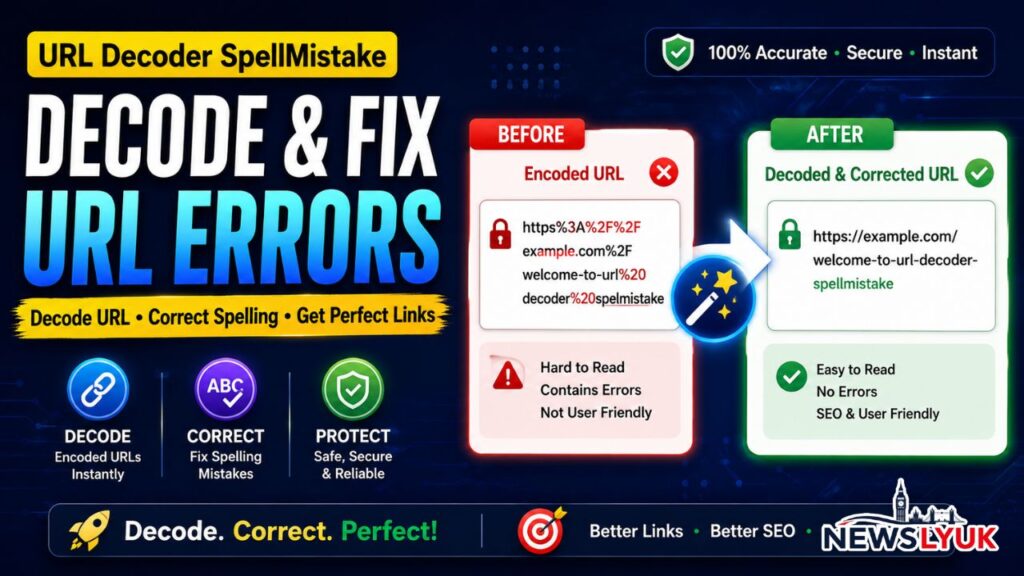

A url decoder spellmistake is one of those quiet, invisible problems that can sit inside a codebase for months before someone notices. It doesn’t throw a dramatic error. It doesn’t crash your application. It just silently corrupts data, mangles query strings, and leaves developers scratching their heads wondering why their links look like alien text. I’ve seen it happen in production systems at mid-sized SaaS companies, inside marketing automation platforms, and on e-commerce checkout pages — all places where getting the URL exactly right is the difference between a conversion and a lost customer.
The frustrating part? A url decoder spellmistake is usually one character off. One transposed letter. One underscore where there should be a camelCase bump. That’s all it takes.
What Exactly Is a URL Decoder, and Why Do People Keep Misspelling It
Before fixing the mistake, it helps to understand what we’re working with. URL decoding is the process of converting percent-encoded characters back into their original, human-readable form. When a URL travels across the internet, spaces become %20, ampersands become %26, and special characters get wrapped in those familiar percent-sign codes. The decoder reverses that transformation.
In JavaScript, the two primary functions for this job are decodeURI() and decodeURIComponent(). In Python, it’s urllib.parse.unquote(). In PHP, it’s urldecode(). Each of these has a specific scope — decodeURIComponent() handles the full encoded string including characters like / and ?, while decodeURI() deliberately leaves structural URI characters alone. Mixing them up is its own class of error, separate from the url decoder spellmistake problem, but equally damaging.
The spelling confusion typically happens because developers are often typing fast, relying on autocomplete that isn’t configured correctly, or copying function names from memory after reading documentation hours earlier. The most common url decoder spellmistake variants I’ve personally encountered in code reviews include decodeURIcomponent (lowercase ‘c’), decodeUriComponent (lowercase ‘ri’), urldecoder as a single lowercase word when referencing Java classes, and url_decode when working in a JavaScript context where that underscore-style simply doesn’t exist. Each of these will fail silently or throw a ReferenceError that only surfaces under specific conditions — usually in production, never in local testing.
The Real-World Damage a URL Decoder SpellMistake Causes
Here’s what most tutorials won’t tell you: the consequence of a url decoder spellmistake isn’t always obvious at the point of failure. I reviewed a case at a content management platform where a developer had written decodeURIcomponent — missing the capital ‘C’ — inside a function that processed incoming webhook payloads. For six weeks, it worked fine because the test data never included characters that required decoding. The moment a client’s campaign used a URL with a + symbol in the tracking parameter, the whole pipeline broke. Not loudly. Quietly. The + signs stayed encoded, the data went into the database malformed, and the analytics reports showed nonsensical traffic sources for nearly a month before anyone connected the dots.
That’s the real cost of a url decoder spellmistake — not the five minutes it takes to fix, but the hours of forensic investigation to even find it. Modern JavaScript engines will throw ReferenceError: decodeURIcomponent is not defined in some environments, but in others — particularly in older Node.js setups or environments with certain polyfills — the error handling might swallow that exception entirely, returning undefined and letting the corrupted value flow downstream into your application logic.
Where URL Decoder SpellMistakes Hide Most Often
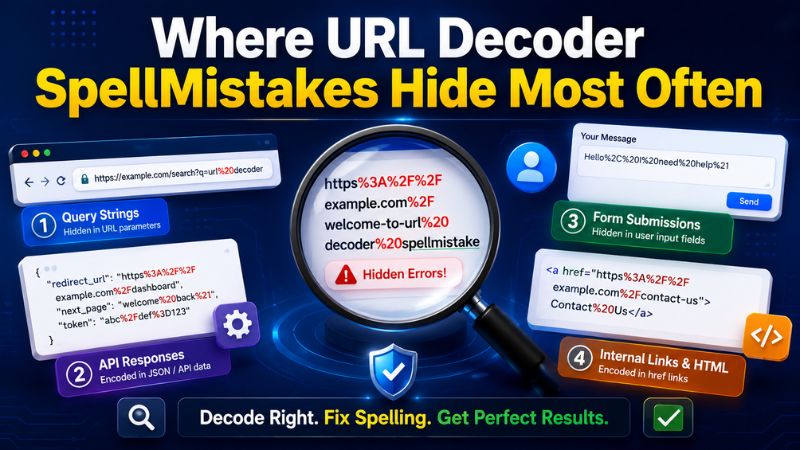
Knowing the common hiding spots matters as much as knowing what the mistake looks like. In my experience auditing codebases for SEO and performance issues, url decoder spellmistakes cluster in predictable locations. They appear most frequently inside analytics tracking scripts, where someone has quickly patched a URL parameter handler without running it through a linter. They show up in server-side rendering functions where query strings are parsed before being passed to templating engines. And they’re remarkably common inside third-party integration code — the kind of glue code that’s written once, never tested thoroughly, and then forgotten until something breaks.
Another hotspot is build pipelines. When a team uses webpack, Vite, or a custom Gulp setup, URL handling functions sometimes get manually written into configuration files rather than imported from a trusted library. These config files often skip the linter entirely. A url decoder spellmistake buried in a webpack.config.js file can affect every URL in your entire application without ever surfacing as a JavaScript error in the browser console.
The third hiding spot is documentation-driven development — specifically, when developers copy code examples from Stack Overflow or blog posts that were written years ago, when naming conventions were less standardized. Some older posts casually use URLDecoder (Java-style capitalization) in a JavaScript context, planting the seed of a url decoder spellmistake before the developer has even opened their code editor.
How to Audit Your Codebase for This Problem Right Now
The good news is that a url decoder spellmistake is one of the most catchable errors once you know what to look for. A simple global search across your project directory will surface most instances in under two minutes. Open your terminal and run a recursive grep for every variation of the word “decode” — grep -ri “decode” ./src — then scan the output for anything that doesn’t match the exact spelling of your language’s native function. In JavaScript, you should only ever see decodeURI or decodeURIComponent with that precise capitalization. Anything else is either a custom function (which should be clearly documented) or a url decoder spellmistake waiting to cause problems.
Beyond manual grep searches, configure your ESLint setup to flag unknown global functions. The no-undef rule, when properly enabled, will catch a misspelled decodeURIcomponent before it ever reaches a pull request. If your team uses TypeScript, this protection comes built-in — the type system simply won’t recognize a nonexistent function name, and the compiler will reject it outright. This is one of the quieter arguments for adopting TypeScript in projects where URL handling is business-critical, like affiliate tracking systems, link shorteners, or any platform where UTM parameters drive revenue attribution.
For Python projects, a url decoder spellmistake often looks like urllib.parse.unquote_plus being written as urllib.parse.unquotePlus (JavaScript-style camelCase creeping into Python territory), or url_decode borrowed from PHP muscle memory. Running pylint or mypy on your codebase will flag these immediately. The investment in static analysis tooling pays itself back the first time it catches one of these before deployment.
Best Practices to Prevent URL Decoder SpellMistakes in Team Environments
Prevention at the individual level is straightforward — slow down, use autocomplete, run your linter. But preventing a url decoder spellmistake across a team of five, ten, or twenty developers requires structural solutions. The first is standardizing URL utility functions into a single shared module. Instead of every developer calling decodeURIComponent() directly throughout the codebase, create a urlUtils.js file with a clearly named wrapper like decodeQueryParam(). Now there’s only one place in the entire project where the native function name is spelled — and that file gets reviewed carefully once, not a hundred times across a hundred files.
The second structural fix is pre-commit hooks. Tools like Husky combined with lint-staged can run ESLint against every changed file before a commit is even accepted. A url decoder spellmistake that would have slipped through code review at 4:30 on a Friday gets caught before the developer can push it to the branch. This isn’t about micromanagement — it’s about building a safety net that works even when humans are tired or rushing.
The third practice, which most teams overlook, is writing integration tests that specifically use special characters in URLs. Most test suites use clean, simple strings that don’t trigger encoding issues. Deliberately write test cases where your URLs contain %20, %2B, %26, and %3D. If a url decoder spellmistake exists anywhere in the relevant code path, these tests will expose it immediately.
Why This Matters for SEO More Than You Might Think
Google crawls URLs. That’s not a revelation. But what surprises a lot of development teams is how a url decoder spellmistake on the server side can affect indexability. When Googlebot follows a link and the destination page fails to decode its own query parameters correctly — because the decoding function was misspelled and silently failed — the page may render without critical content that was supposed to be populated from those parameters. Canonical tags can break. Hreflang attributes can point to malformed URLs. Pagination parameters can go unread, causing Googlebot to treat paginated pages as duplicates.
I’ve seen a url decoder spellmistake inside a dynamic URL generation function cause an entire category of product pages to serve identical content to search engines for three months. The fix took twenty minutes. The SEO recovery took four months. That asymmetry — trivial to fix, expensive to recover from — is why this deserves serious attention from anyone responsible for a crawlable web property.
FAQs
Q1: What is the most common url decoder spellmistake in JavaScript?
The single most frequent error is writing decodeURIcomponent with a lowercase ‘c’ instead of the correct decodeURIComponent. JavaScript is case-sensitive, so this will throw a ReferenceError in strict environments or return undefined in others, silently corrupting any data that passes through it.
Q2: Will my browser console always show an error if I make a url decoder spellmistake?
Not always. If the misspelled function call is wrapped in a try-catch block, or if the error occurs inside an async function with a swallowed promise rejection, the browser console may show nothing. This is why static analysis tools and linters are more reliable than depending on runtime errors to surface the problem.
Q3: Does a url decoder spellmistake affect SEO rankings directly?
Not directly — Google doesn’t penalize misspelled function names in your source code. But the downstream effects absolutely matter for SEO. Broken URL decoding can cause pages to render incorrect content, break canonical tags, or serve duplicate content to crawlers, all of which negatively impact indexing and rankings over time.
Q4: Is there a difference between a url decoder spellmistake in Python versus JavaScript?
Yes. In Python, the correct function is urllib.parse.unquote() or urllib.parse.unquote_plus(). Python developers most commonly make the url decoder spellmistake by using camelCase (unquotePlus) borrowed from JavaScript habits, or by trying to call urldecode() which is a PHP function and simply doesn’t exist in Python’s standard library.
Q5: How do I check if a url decoder spellmistake is already in my production codebase?
Run a recursive search using grep -ri “decode” ./ in your project root and review every result carefully against the official documentation for your language. Then enable your linter’s no-undef rule (for JavaScript) or run a type checker like mypy (for Python). These two steps together will catch the vast majority of existing url decoder spellmistakes.
Q6: Are there any online tools that help catch a url decoderspell mistake before deployment?
Yes. Tools like JSHint, ESLint (with the no-undef rule enabled), and TypeScript’s compiler will catch misspelled native function names at the code level. For quick, one-off testing, online URL decoder tools at sites like urldecoder.org or meyerweb.com’s URL decoder let you manually test how your URLs behave after decoding — useful for verifying that your decoding logic produces the expected output before you ship.
You May Also Read: The Power Dynamics of Male Hairlines in High Finance