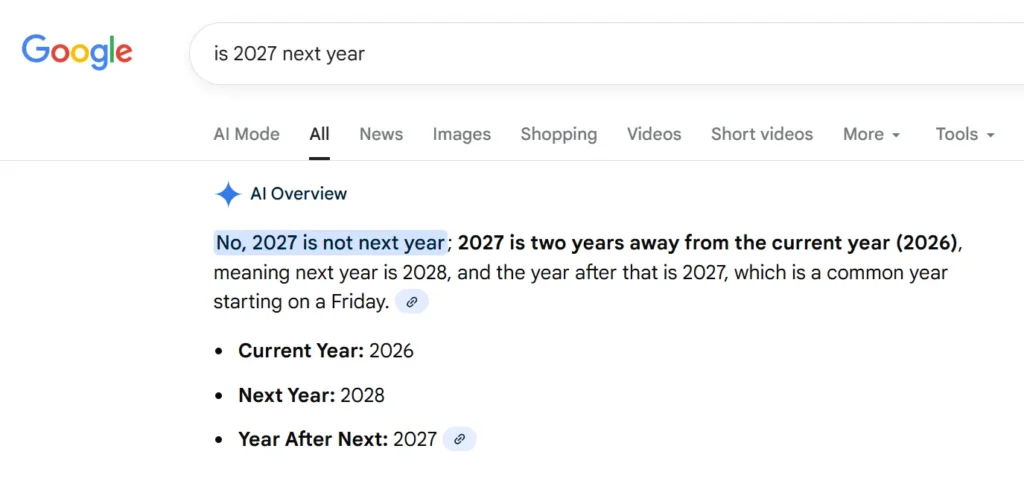

If you’ve recently searched “is 2027 next year”, you’re certainly not alone. Thousands of people across the United States, the United Kingdom, and beyond have been asking this surprisingly simple question—not because the calendar suddenly changed, but because Google’s AI Overview and related AI tools briefly produced an incorrect answer that quickly went viral.
Here’s the short answer:
Is 2027 next year? Yes. If the current year is 2026, then 2027 is the immediate next calendar year.
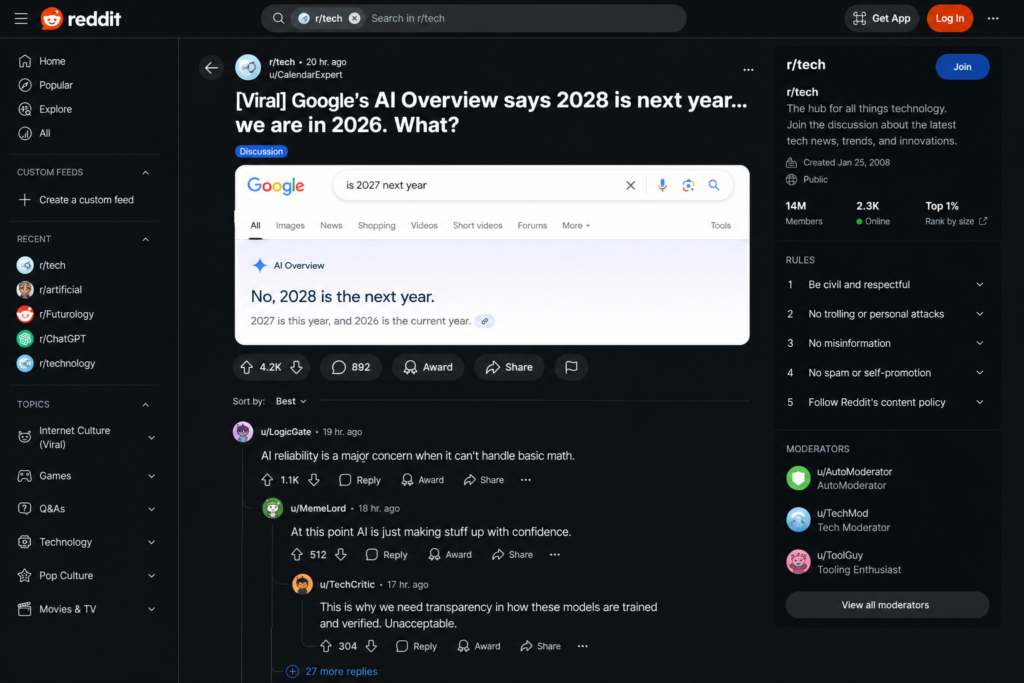
Although this is basic calendar math, screenshots circulating on Reddit, X (formerly Twitter), and other platforms showed Google’s AI Overview claiming that 2028 would be next year while placing 2027 after it. The incorrect response spread rapidly, sparking jokes, memes, and renewed discussions about whether artificial intelligence truly understands time or simply predicts the most likely sequence of words.
This article separates fact from fiction, explains what happened, explores why AI systems occasionally make mistakes with dates, and answers every common question people are searching for—including “is 2027 next year AI overview,” “is 2027 next year Google AI,” “is 2027 next year Gemini,” and “is next year going to be 2027 or 2028?”
Is 2027 Next Year? The Direct Answer
Featured Snippet
Is 2027 next year? Yes. Because the current year is 2026, adding one year makes 2027 the immediate next calendar year.
There is no ambiguity in the Gregorian calendar.
| Current Year | Next Year | Following Year |
| 2026 | 2027 | 2028 |
This sequence has remained unchanged for centuries and forms the basis of the internationally accepted Gregorian calendar.
How to Calculate the Next Calendar Year
- Identify the current year (2026).
- Add 1 to the current year.
- 2026 + 1 = 2027.
- Verify that 2027 immediately follows 2026.
That’s all there is to it.
Yet millions of users became confused because Google’s AI-generated answer temporarily contradicted this simple calculation.
Why So Many People Are Searching “Is 2027 Next Year”
Normally, almost nobody needs to ask whether one year follows another. Calendar progression is among the simplest facts people learn in school. So why did this search term suddenly trend?
The answer lies in the growing popularity of AI-powered search experiences.
Google’s AI Overview attempts to answer questions directly instead of simply listing webpages. It gathers information from multiple online sources and generates a concise summary at the top of search results. While this feature often saves users time, it has also been criticized for producing confidently written—but occasionally incorrect—answers. Earlier well-known examples included recommending glue on pizza and other factual errors, and the “is 2027 next year” incident became another high-profile case.
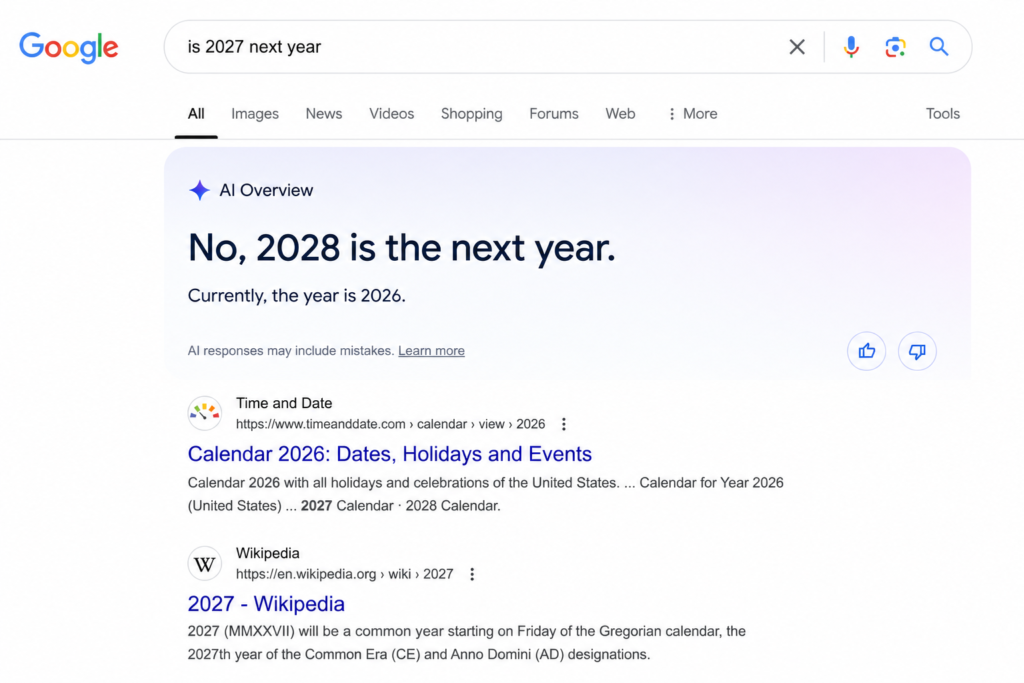
When users typed “is 2027 next year”, some AI Overview responses incorrectly claimed:
“2027 is two years away… next year is 2028.”
The statement contradicted itself because if the current year is 2026, then 2027 must logically come next. Technology publications quickly reported on the anomaly, and screenshots spread widely across Reddit, Bluesky, and X, where users joked that AI had “invented a new calendar.”
Why Google AI Overview and Gemini Got “Is 2027 Next Year” Wrong
At first glance, the mistake seems almost impossible. How could an advanced AI system fail at something as simple as determining which year comes after 2026?
The answer lies in how large language models (LLMs) work. Unlike a calculator or a calendar application, an LLM does not “count” years step by step. Instead, it predicts the most likely sequence of words based on patterns learned from vast amounts of text. Most of the time, this produces accurate and natural responses. Occasionally, however, the model generates a confident but incorrect statement—a phenomenon widely known as an AI hallucination.
In the case of “is 2027 next year”, Google’s AI Overview reportedly produced contradictory answers such as:
- “No, 2027 is not next year.”
- “2028 will be next year.”
- “2027 will come after 2028.”
These responses violated basic calendar logic, yet they were presented with confidence. Screenshots of the error spread quickly across Reddit, X (formerly Twitter), and Bluesky, turning a simple search query into a viral internet meme.
It is important to understand that this wasn’t evidence of the Gregorian calendar changing. Instead, it highlighted a known limitation of generative AI systems: they generate language probabilistically rather than performing deterministic reasoning for every response.
Is This a Google AI Problem or an AI Problem?
Many users searched for:
- is 2027 next year ai overview
- is 2027 next year google ai
- is 2027 next year gemini
- is 2027 next year ai
The incident involved Google AI Overview, Google’s AI-generated search summaries. Some users also associated the mistake with Gemini, because AI Overview is powered by Google’s AI technology. However, not every AI assistant produced the same incorrect response. Different AI systems use different models, retrieval methods, and safeguards, so answers can vary between platforms.
This is one reason experts recommend verifying AI-generated information—especially when it concerns factual, time-sensitive, legal, financial, or medical topics.
AI Hallucinations Explained in Simple Terms
Think of an AI language model as an exceptionally skilled autocomplete system.
Instead of checking a live calendar every time you ask a question, it predicts which words are statistically most likely to follow your prompt. Most predictions are accurate, but sometimes the model produces information that sounds convincing while being objectively false.
Researchers call these outputs hallucinations. They don’t mean the AI is “imagining” things in a human sense. Rather, the model has generated text that isn’t supported by facts. Hallucinations have been observed across many AI systems, which is why developers continue investing in better grounding, retrieval, and validation techniques.
Will It Be 2027 After 2026?
Yes. In the Gregorian calendar, 2027 always follows 2026. If the current year is 2026, then 2027 is the immediate next year, while 2028 is the year after that. There is no scenario in the standard calendar where 2028 comes before 2027.
2025 → 2026 → 2027 → 2028
Each calendar year increases by exactly one.
Therefore:
- 2026 + 1 = 2027
- 2026 + 2 = 2028
No matter where you live—whether in the United States, the United Kingdom, or elsewhere using the Gregorian calendar—the sequence remains the same.
Why the Mistake Became a Viral Meme
One reason the story spread so quickly is that the mistake was instantly understandable.
Unlike a complex programming error or obscure scientific claim, everyone knows the order of calendar years. That made the contradiction immediately obvious and highly shareable.
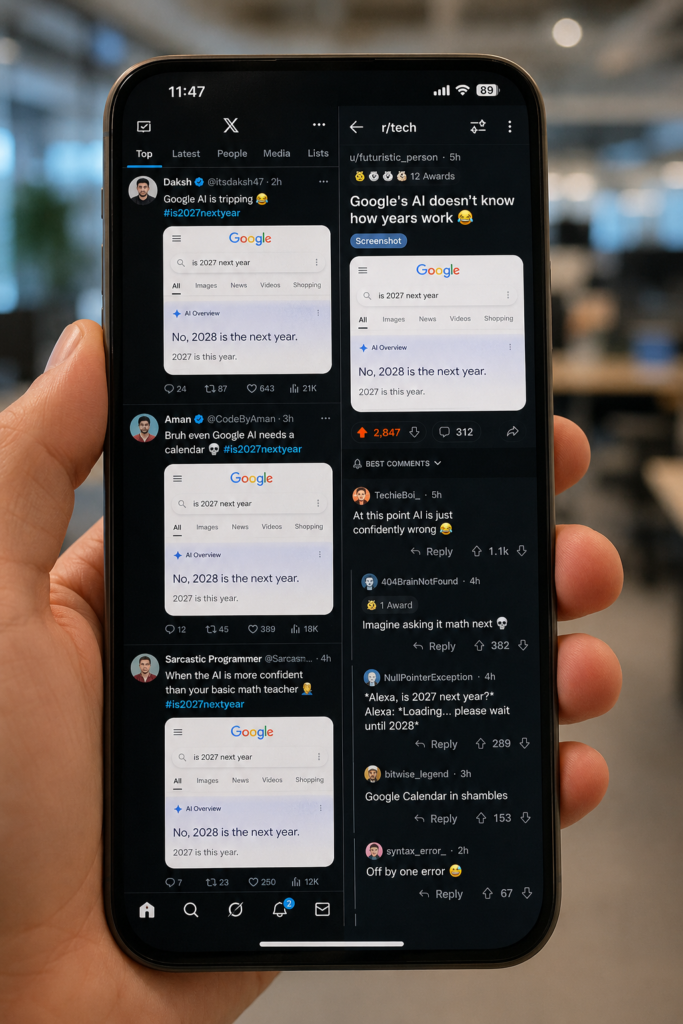
Users across Reddit joked that Google had “invented a new timeline,” while others posted humorous edits suggesting that AI had skipped an entire year. Some compared the incident to previous AI Overview blunders, including the widely discussed “glue on pizza” recommendation that had already raised concerns about AI-generated search summaries.
The discussion also sparked a broader conversation about trust in AI-powered search. As more people rely on AI-generated answers instead of clicking through to websites, even small factual mistakes can spread rapidly and confuse users. This has led researchers, publishers, and technology companies to place greater emphasis on improving factual accuracy, citation quality, and verification mechanisms in AI search products.
Viral Memes and Social Media Reactions (Reddit & X)
One of the biggest reasons “is 2027 next year” became a trending search wasn’t the incorrect AI answer alone—it was how quickly the internet turned it into a meme.
Within hours of screenshots appearing online, users across Reddit, X (formerly Twitter), Bluesky, and other social platforms began sharing and parodying Google’s AI Overview. Many couldn’t believe an AI capable of writing essays and generating code had stumbled over a question that most children could answer.
One Reddit user shared a screenshot showing AI Overview claiming:
“No, 2027 is not next year; 2027 is two years away from the current year (2026), meaning next year is 2028.”
The contradiction was immediately obvious and sparked thousands of comments and reposts.
Popular Community Reactions
Reddit discussions generally fell into a few categories:
- Users joking that AI had “invented a new calendar.”
- Developers explaining that LLMs are probabilistic rather than deterministic.
- Others pointing out that different users were seeing different AI Overview responses because the system isn’t perfectly consistent.
Some humorous comments included:
- “Breaking news: next year is 2028.”
- “AI skipped an entire year.”
- “Computers have known the date for decades, but AI somehow forgot.”
Although much of the discussion was lighthearted, it also highlighted an important point: users increasingly expect AI-powered search to be reliable for straightforward factual questions.
Is Next Year Going to Be 2027 or 2028?
This is another People Also Ask (PAA) question that surged after the viral screenshots.
Direct Answer
If the current year is 2026, then:
| Current Year | Next Year | Year After Next |
| 2026 | 2027 | 2028 |
Therefore:
- Is 2027 next year? Yes.
- Is 2028 next year? No.
- Will it be 2027 after 2026? Yes.
There is no exception under the standard Gregorian calendar used in the United States, the United Kingdom, and most of the world.
How Large Language Models (LLMs) Struggle with Real-Time Dates
The “is 2027 next year” incident provides a useful example of one of the most discussed limitations of generative AI.
Unlike a traditional software application that retrieves information from a fixed database or performs arithmetic operations directly, an LLM generates responses by predicting likely text sequences. While modern AI systems increasingly combine language generation with retrieval and external tools, they can still produce logical inconsistencies—especially when multiple pieces of information conflict during generation.
Several factors can contribute to these mistakes.
Training Data vs. Live Information
AI models learn from enormous datasets created over time. If a model relies heavily on historical patterns without correctly grounding its response in the current date, it may become confused about relative time expressions such as:
- Next year
- Last year
- Two years from now
- This year
This is why many AI systems use retrieval, live search, or system time to improve factual accuracy.
Probabilistic Text Generation
When answering a question, an LLM does not “calculate” in the same way a calculator does.
Instead it predicts:
“Given everything I’ve seen before, what words are most likely to come next?”
Usually this works remarkably well.
Occasionally it produces contradictions such as:
- Current year = 2026
- Next year = 2028
- Year after next = 2027
Humans instantly recognize the inconsistency because we apply logical reasoning rather than statistical language prediction.
Why AI Sometimes Corrects Itself
Interestingly, some AI assistants initially produced the wrong answer before immediately correcting themselves.
Technology journalists observed that certain conversational AI systems responded:
“No, 2027 is not next year…”
before reconsidering and replying:
“Actually, yes—since the current year is 2026, 2027 is next year.”
This self-correction demonstrates that modern AI can often detect contradictions after additional reasoning, even if its first response is incorrect.
Is 2027 Next Year? AI Overview Meme Explained
The phrase “is 2027 next year AI overview meme” has become a popular search because people want to understand the joke behind the screenshots.
The meme works because it combines two things:
- An extremely simple question
- An unexpectedly incorrect AI answer
That contrast makes the result funny and memorable.
Rather than being about calendar mathematics, the meme has become shorthand for moments when AI appears highly intelligent in complex tasks but unexpectedly fails at basic logic.
As with earlier viral AI mistakes, the incident reminded users that AI-generated summaries should be treated as helpful starting points—not unquestionable facts. Cross-checking information with reliable sources remains a good habit, particularly for factual or time-sensitive topics.
Conclusion
So, is 2027 next year? The answer is yes—if the current year is 2026, then 2027 is the immediate next calendar year, and 2028 comes after that. The viral confusion wasn’t caused by a change in the calendar but by an AI-generated response that briefly contradicted basic chronology.
The incident quickly evolved into a popular internet meme, prompting discussions about AI accuracy, reasoning, and the importance of verifying AI-generated information. For more stories like this, visit our Tech News section. While modern AI tools are powerful and increasingly useful, they can still produce confident but incorrect answers, especially when handling relative dates or logical reasoning.
If you found this guide helpful, explore more technology coverage for fact-checks, AI updates, and practical explainers on the latest developments in artificial intelligence.
You may also read: Pricing, Availability, and Market Position